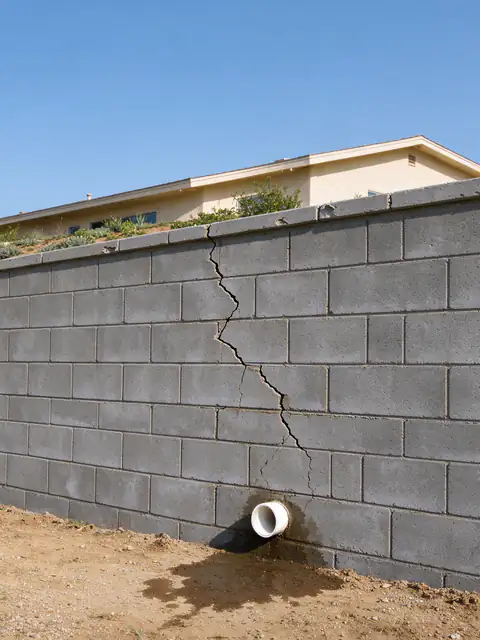
What should you check on a retaining wall after heavy rain?
The signs worth looking for once a storm passes, how to look without putting anyone at risk, and why short bursts of San Diego rain are hard on walls built for a dry climate.
Last Updated:
Short answerAfter heavy rain, look at the wall from a safe distance for new lean, bulging, cracks, soil washing out at the base or ends, and outlets that stayed dry while the ground behind stayed wet. Keep people and pets away from anything below a wall that is moving, and have it assessed before digging, backfilling or reloading it.
A retaining wall after heavy rain is carrying the most load it will see all year: soil that weighs more because it is wet, water pressure behind the face if the drains can’t keep up, and runoff working at the base and ends. A wall with clear drains and a sound footing is built for that load, and the days right after a storm are when a wall that is not keeping up shows it. This guide from Batterline San Diego Retaining Walls, which offers and manages retaining wall repair and replacement across San Diego County, covers what an owner can safely check once the rain stops and when to keep everyone away. Batterline doesn’t send anyone out during a storm, so the first look is yours.
Why heavy rain is hard on San Diego walls
San Diego gets little rain, and that is part of the problem. NOAA’s 1991-2020 normals put Lindbergh Field at 9.79 inches a year, El Cajon at 11.63 and Ramona at 14.42, and about 83% of each station’s total falls from November through March. Much of that arrives in a few storms that land on dry, sometimes clay-rich backfill.
Short, intense rain is what overwhelms a wall. On January 22, 2024, Lindbergh Field recorded 2.73 inches, the highest daily total in the station’s record back to 1939, per NOAA data; the next highest days in that record were 2.70 inches on October 27, 2004 and 2.60 on December 22, 1945. A day like that fills drainage gravel faster than weep holes and pipes can empty it, saturates the soil behind the wall and adds hydrostatic pressure the wall may never have been designed for. Older walls are more exposed: about half the City’s housing was built before 1980, so many existing walls likely predate current drainage and inspection rules, though housing age is not wall age.
Look from a safe distance first
Before checking anything, decide where to stand. A wall that has moved can keep moving, and the ground above it can be weaker than it looks.
Stay out from below. Don’t stand, park or let children and pets play at the base of a wall that leans, bulges or has dropped soil.
Stay off the top. Keep people, cars and equipment off the slope or yard behind a wall that has moved, since added weight is a surcharge.
Look from the side. Sight along the wall from one end, at a distance, and compare it with older photos if you have them.
Don’t dig or probe. Digging at the toe or behind the wall to see what is wrong removes support.
Turn irrigation off above the wall until it has been looked at.
If anyone is hurt, the house is threatened or a gas or water line is damaged, call 911 or the utility before anything else.
What to look for
Sign after the storm
What it can mean
How urgent
New lean, or a lean that has grown
Water pressure, a base that moved or reinforcement that is falling short
Assess soon; keep clear below
A bulge partway up the face
Pressure concentrated mid-height; units or stem yielding
Assess soon; keep clear below
Fresh cracks, or old cracks wider
Movement in a block or concrete wall
Assess; photograph with a scale
Soil or gravel spilling at the base, ends or through joints
Washout of backfill or fines through the wall
Assess soon
Ground cracks, a dip or a sinkhole behind the wall
Soil washing out from behind or the slope moving
Keep clear; assess promptly
Weep holes dry while the ground behind stays soaked
Blocked drains or no drainage behind the wall
Assess before the next storm
Wall drains running muddy
Fines migrating through a failed filter
Assess before the next storm
Several of these together, or any sign that keeps changing day to day, raise the urgency. A single sign doesn’t prove a single cause; base settlement, overload and blocked drains can all produce the same lean. The leaning wall guide goes through the causes.
Washout and foundation erosion
Two kinds of damage start at the bottom of a wall and are easy to miss. Soil washout happens when water moving through or around the wall carries backfill with it. It leaves voids behind the face, sinkholes or dips on the ground above, and soil or gravel spilling from joints and weep holes. Where drainage gravel was placed without a filter fabric, the fine soil migrates into it and the drain slowly clogs; the weep hole guide explains how drains and weeps are meant to work.
Foundation erosion happens at the toe and the ends, where runoff concentrates. Water pouring off a roof, a patio or the top of the wall and running along its base cuts away the soil in front of the footing, reducing the embedment that keeps the wall from sliding. Undermining at the ends shows as a gap under the first course or a footing edge that is suddenly exposed. Neither is a face problem: refilling the hole or patching the joint leaves the cause in place, which is why the repair or replace guide treats undermining as a reason to look below the surface.
Surface grading and runoff above the wall
Much of the water that hurts a wall arrives on the surface, not through the soil. Ground at the top of a wall that slopes toward it sends every storm’s runoff into the backfill; ground graded away from it, or a swale that carries water along the wall to a safe outlet, keeps most of that water out. The same is true of downspouts and patio drains that empty just behind a wall. The City’s standard wall design requires the wall drain to discharge to a stormwater system, never onto an adjoining property (IB 221), and City grading that concentrates runoff onto neighbors needs a grading permit (SDMC 129.0602). Wall drainage is designed for the water that gets into the backfill; surface grading keeps that amount small. Yard-wide drainage systems are a separate trade and not offered here, but the retaining wall drainage page covers drainage at the wall itself.
When to keep people away
Treat the area below a wall, and a band above it, as off limits when the wall has visibly moved since the storm, when the lean or a crack keeps growing, when soil keeps dropping from the face, or when cracks open in the ground above. Keep it that way until someone qualified has looked. Where the slope itself has moved, not just the wall, a geotechnical engineer is the right first assessment, and slope repair may be part of the answer.
Document as you go: dated photos from the same spots, a tape measure against cracks, and notes on where water came out. That record helps an insurer, an engineer and anyone pricing the repair. Policies differ on earth movement and retaining walls, so ask your insurer directly; the storm damage insurance guide lists the questions to ask.
Getting the wall assessed
Once the rain stops and the wall is stable enough to approach, the first visit measures the wall’s length, exposed height and height from the top of the footing, notes lean, bulging and cracks, checks drains, weep holes and irrigation, and looks at what sits above and how the work could be reached. That separates a cleared outlet from a rebuilt section. Call (619) 374-2499 or ask for an estimate with your photos. For the checks worth doing before the wet season, see checking a retaining wall before the rainy season.
02
More questions on this
Who should be called first when a retaining wall collapses after rain?
If anyone is hurt, a house is threatened or a utility line is damaged, call 911 or the utility first. Otherwise keep people away from the debris and the ground above it, photograph everything from a safe spot and contact your insurer, since policies differ on earth movement. Then have the wall and slope assessed; a geotechnical engineer is often needed when the slope itself moved.
Can a homeowner brace a retaining wall that moved in a storm?
It isn't a good idea. A wall that has moved is carrying more load than it was built for, and propping timber or soil against it means working right where it would fall. Whether a moving wall needs temporary support, and what kind, is an engineering decision. Keep people clear, take the load off the top, turn off irrigation and have it assessed.
Does covering a slope with plastic sheeting protect a retaining wall during storms?
It can help for a short time on bare, freshly disturbed soil above a wall, because sheeting sheds rain that would otherwise soak in or carry soil away. It also concentrates runoff where the sheets end, so that water needs a safe path that doesn't pour over or behind the wall. Sheeting is a stopgap, not a repair, and it shouldn't hide cracks someone needs to see.
03
Get an Estimate for retaining wall repair
Tell us what the wall is doing, how tall it is from the lowest visible point, what sits above it and your ZIP code. Photos of the face, the top and any drain outlets make the first conversation more useful.
The pressures that push a wall over, the three ways walls move, why San Diego's rain pattern and clay matter, and how to record the lean before anyone visits.
Why every retaining wall needs an outlet for water, how weep holes compare with a perforated back drain, what San Diego's City and County designs call for, and what water and stains on the face are telling you.
Why no one but your insurer can answer the coverage question, the questions to put to them, how to document a wall before and after a storm, and why public disaster money rarely reaches private slopes.
The three scopes a failing wall can get, the buried conditions that decide between them, how reinforcement is checked when you can't see it, and what changes in permits and price.
The fire, hillside, open space and geology rules that apply where a San Diego yard meets a canyon, and who is responsible for the slope below the fence.